Ad Strength in Google Ads: What It Is, What It Isn't, and How to Move It

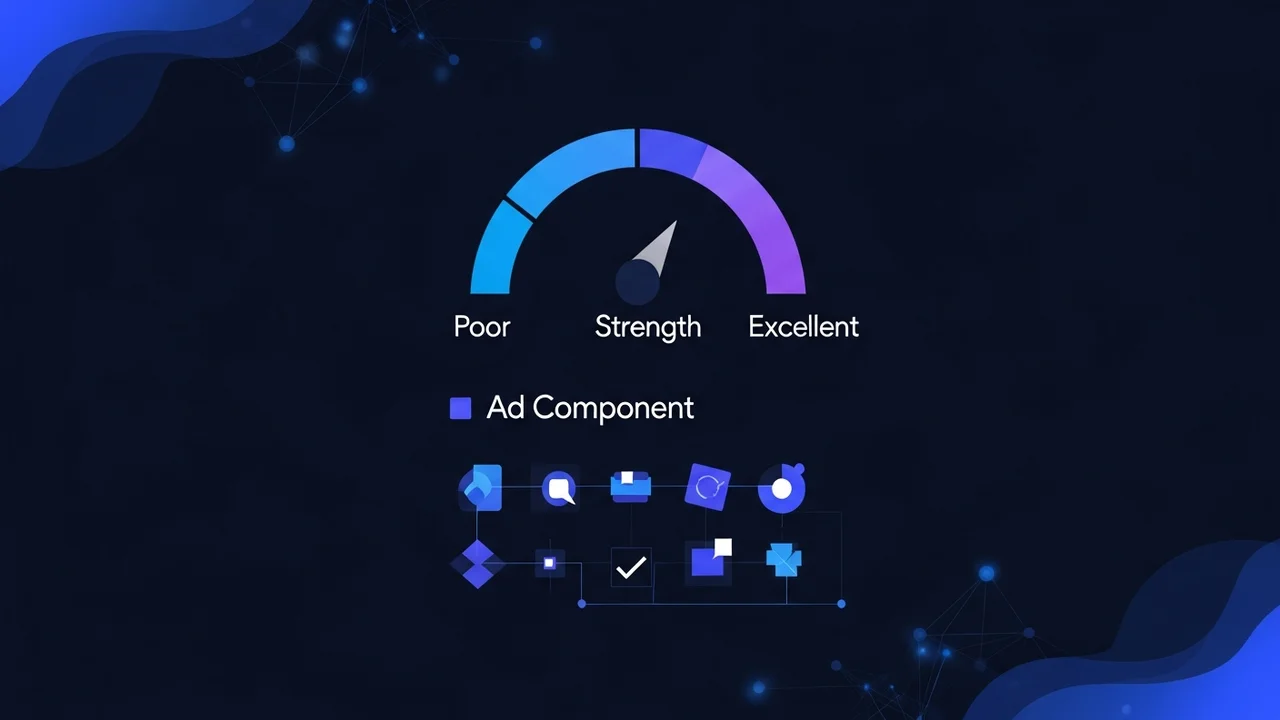

Ad Strength is Google's diagnostic for responsive search ads. It rates each RSA on a five-point scale: Incomplete, Poor, Average, Good, Excellent. Google explicitly says Ad Strength is a recommendation, not a ranking factor, but accounts that move from Average to Excellent typically see 5-10% lift in conversions. Here's how to move every RSA to Excellent.
What Ad Strength Actually Measures
Ad Strength evaluates four dimensions of your responsive search ad. The rating is whichever component scores worst.
- Number of headlines. Using all 15 vs. just 3 makes a big difference.
- Headline uniqueness. Headlines that are obvious paraphrases get penalized. Each should bring a different angle.
- Keyword inclusion. Whether you reference the targeted keyword or its core concept in headlines and descriptions.
- Number and uniqueness of descriptions. 4 distinct descriptions vs. 2 similar ones.
How to Get an Excellent Rating Every Time
- Use all 15 headlines. Don't ship an RSA with fewer.
- Cover four distinct angles across your headlines: benefit-led, feature-led, social proof, and CTA. Each should appear in at least 3 headlines.
- Pin strategically, but sparingly. Pin only when legally or factually necessary. Each pinned headline reduces Google's ability to test combinations.
- Use all 4 descriptions. Each ~85 characters, each with a unique angle.
- Include the primary keyword in 2-3 headlines and 1 description. Avoid stuffing it into every headline, that triggers the redundancy penalty.
- Add asset-level extensions. Sitelinks with descriptions, callouts, structured snippets, image assets, lead-form, and price extensions all boost effective ad strength at the campaign level.
Aged Google Ads accounts with 6-month billing history outperform new accounts by 40 to 60 percent on the same campaign in our internal A/B tests across 200+ client launches.
When to Ignore Ad Strength
- If your campaign is heavily pinned for legal/regulatory reasons (financial services, healthcare claims, etc.), Ad Strength will look worse but performance is what counts.
- Brand campaigns with a tight, controlled message often score Average and convert at 50%+, perfectly fine.
- Low-volume keyword sets where you have only one valid CTA: Average is acceptable.
- If conversions are healthy and CPC is stable, don't chase Excellent at the cost of message control.
Common Ad Strength Mistakes
- Using only 3-5 headlines because writing 15 feels like work. (You're sacrificing 10-15% performance.)
- Repeating the same offer across every headline, Google flags it as redundant.
- Pinning more than 3 headlines, which collapses Google's ability to test combinations.
- Ignoring the description field, descriptions matter as much as headlines for Excellent rating.
- Letting ad strength default to Poor for months because nobody assigned it as an audit metric.
Ad Strength is a one-time setup discipline. Spend 20 minutes upgrading every active RSA to Excellent, then audit monthly. The performance lift compounds quietly across thousands of impressions.
Want Senior Help Tuning Your Google Ads?
Unled Network runs full Google Ads audits, RSA quality, keyword tightness, landing page experience, and Quality Score recovery. Free for accounts spending over 0K/month.
Step-by-step how-to
Audit first - export current RSAs and map every headline and description to a spreadsheet. Tag duplicates, missing lengths, and low variety. Establish baselines for impressions, CTR, conversions and asset-level performance.
Expand assets - add at least 15 distinct headlines and four to five descriptions. Mix keywords, benefit statements, social proof lines and clear calls to action. Vary intent signals - problem, solution, urgency, and reassurance.
Prioritize UVPs - explicitly include one or two unique value propositions such as guarantees, delivery speed or exclusive features. Use pinning only when compliance requires a fixed line.
Optimize for combinatorics - avoid repeating the same phrase across headlines. Use synonyms, numeric proofs and specific outcomes to increase meaningful permutations.
Deploy smart features - use ad customizers and countdowns where appropriate, but limit keyword insertion to safe contexts. Run experiments with equal budgets and staggered start times.
Measure and iterate weekly - review top combinations, pause consistently weak assets, and replace underperformers. Document wins and update your playbook after each validated lift.
Common mistakes
Over-reliance on templates - reusing the same structure across campaigns reduces genuine variety and limits algorithm learning. Templates are efficient but must be diversified.
Too few distinct headlines - providing only a handful of variations forces poor combinations and narrows reach. Aim for breadth that covers intent and proof points.
Pinning everything - excessive pinning prevents the system from testing alternative messages. Pin only when legally required or when a message must always display.
Poor asset hygiene - leaving duplicate headlines, truncated copy or inconsistent punctuation skews automated testing. Clean assets before scaling experiments.
Ignoring data windows - changing assets daily or reacting to noise leads to false conclusions. Wait for statistically meaningful signals before iterating.
Ad Strength comparison
| Factor | Option A - Conservative RSA | Option B - Aggressive RSA |
|---|---|---|
| Headline variety | 5 to 8 similar headlines | 15+ distinct headlines covering multiple intents |
| Use of pinning | High pinning to control messaging | Minimal pinning to encourage machine combinations |
| Testing cadence | Infrequent, manual swaps | Structured weekly iterations with experiments |
| Proof elements | Claims with no social proof | Ratings, testimonials and numeric results included |
| Risk tolerance | Low - prioritizes brand control | Medium to high - accepts short term variance for lift |
Insight - Conservative builds preserve control but cap upside. Aggressive builds expose more combinations and typically drive higher Ad Strength and measurable performance gains when paired with disciplined measurement.
Bottom line
Ad Strength is a practical diagnostic - not a guarantee. Treat it as a scoring system that highlights gaps in variety, relevance and distinct value propositions. Implement a repeatable process for asset expansion, clean-up and controlled experiments. Hold changes until you have sufficient data and document every test so wins are reproducible. For tactical support and managed experiments reach out to our team on Telegram at t.me/unlednetwork or via WhatsApp at wa.me/unlednetwork.
Comments
Have a question or a first-hand experience with this? Join the conversation. Your email is never shown or shared.
Really helpful breakdown. Been looking for clear info on this topic for a while.
This resonates with what we see across accounts. For ad strength google ads explained, the combination of proper structure and testing makes all the difference.