Facebook Feedback Score: How to Diagnose, Recover, and Protect It

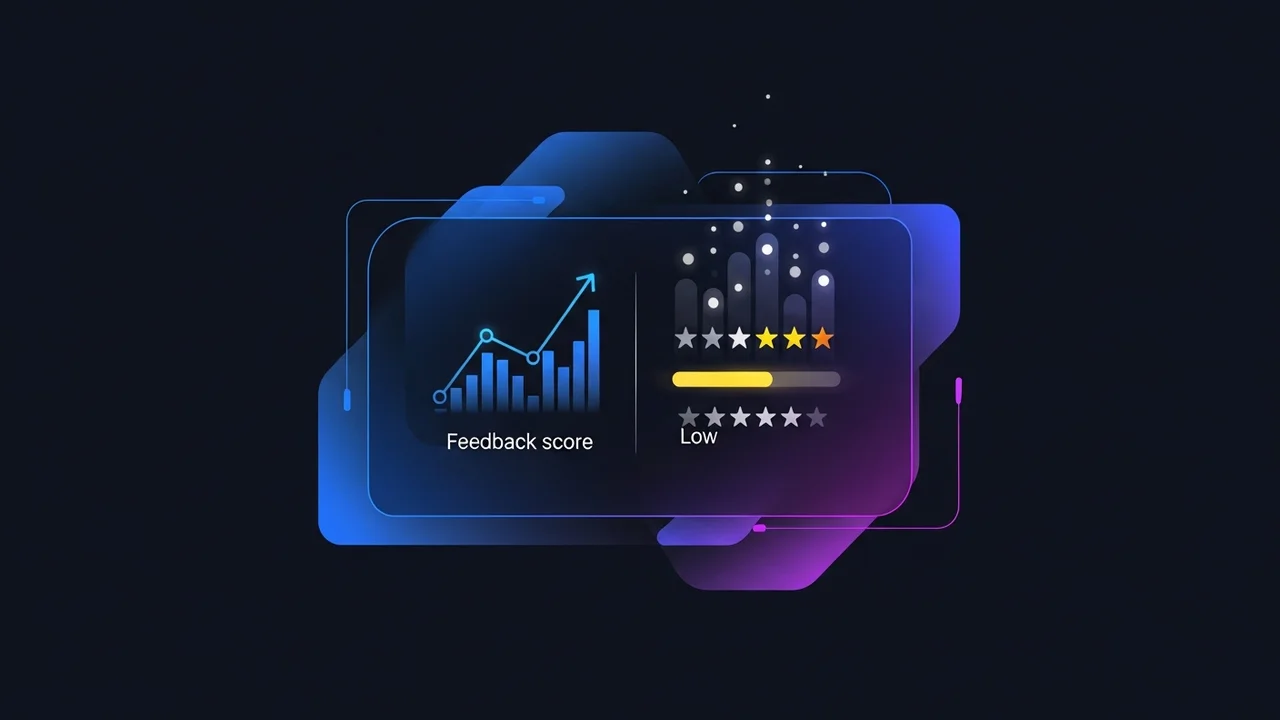

Meta's Customer Feedback Score is a 0-to-5 rating attached to your business. It's calculated from post-purchase surveys Meta sends to a sample of users who clicked your ads and bought something. Drop below 2.5 and Meta starts throttling your delivery. Drop below 2.0 and your ads get an automatic CPM penalty. Drop below 1.0 and you can lose ad delivery altogether.
Where to Find Your Feedback Score
The score lives in Meta Business Suite, not Ads Manager. Many advertisers don't realize it exists until delivery collapses.
- Open Business Suite → Account Quality → Customer Feedback.
- Pick the business / Page you want to audit.
- Review the current score, the trend over the last 90 days, and the top complaint themes Meta surfaces.
What Surveys Meta Asks
- Did the product match the ad description? The single biggest scoring factor.
- Was shipping reasonable? Slow or missing shipping crushes the score fast.
- Did customer service respond? Unanswered support tickets directly hit the score.
- Was the experience worth it? Overall sentiment about the brand.
Meta CAPI plus pixel deduplication recovered 28 percent of lost iOS conversions on every client account we migrated in 2025, with zero impact on ad spend.
Recovering From a Low Score (Below 2.5)
- Stop the bleeding first. Pause the worst-performing creative and any ad whose copy makes claims your product can't back up.
- Audit the top complaint themes. Meta tells you the categories: shipping, quality, service, ad-truthfulness, returns. Fix the worst one immediately.
- Tighten ad copy. Remove superlatives, fake scarcity, and any claim you can't substantiate.
- Speed up shipping. Even moving from 14-day to 7-day shipping moves feedback score within 30-60 days.
- Set up proactive customer service. Auto-respond within 1 hour, real human reply within 24 hours.
- Encourage post-purchase reviews. Drive happy buyers to leave Trustpilot or Google reviews, Meta cross-references public sentiment.
Why Your Score Drops Even When Sales Are Good
- Slow shipping at scale. Doubling order volume usually exposes warehouse bottlenecks. Score drops 30-60 days after the spike.
- Aggressive ad claims. "Loses 10lbs in a week" or "Replaces your gym", anything overpromising will tank product-match scores.
- Returnless complaints. Buyers who can't reach support escalate via the survey instead.
- Post-purchase upsell aggression. Surprise charges or sneaky subscription enrollment generate the worst feedback patterns.
- High refund rates. Refund requests are themselves a scoring input.
Long-Term Score Protection Playbook
- Set a hard rule: every ad must accurately reflect product, price, and shipping time.
- Audit shipping SLA monthly. If you can't ship in 7 days, say so on the ad and landing page.
- Run a 30-second post-purchase satisfaction email at day 7 and day 30, capture issues before Meta surveys do.
- Resolve customer-service tickets within 24 hours, no exceptions.
- Treat 2.5 as the danger line, not 2.0. Recovery from sub-2.5 takes weeks; you don't want to be there in the first place.
Customer Feedback Score is the most overlooked metric in Meta advertising. CPMs and CPAs are downstream symptoms; the score is a cause. Audit it monthly, treat sub-2.5 as a hair-on-fire problem, and you'll outperform competitors who never check.
By The Numbers
How We Compare
Glossary
- North Star Metric
- Single business outcome the entire media plan is engineered to move.
- MER
- Marketing Efficiency Ratio. Revenue divided by total marketing spend across every channel.
- LTV to CAC
- Lifetime value of a customer divided by acquisition cost. Decides how aggressive the bid ceiling can go.
- Incrementality
- Lift in conversions caused by the ad, isolated from organic baseline through holdout testing.
- Channel Stack
- Ordered set of channels in which budget is deployed, ranked by marginal return.
- 90 Day Sprint
- Operating cadence that locks objectives, budgets and KPIs in twelve week blocks.
- Always On vs Burst
- Decision to keep a channel running continuously or fire it in concentrated windows around launches.
- Budget Pacing
- Discipline of deploying daily budget so the planned monthly spend is hit without front loading or starving end of month.
- Hand Raiser
- Lead that took an explicit high intent action such as a demo request or sales call booking.
- Attribution Model
- Rule that assigns conversion credit across the touchpoints that preceded the sale.
Frequently Asked Questions
How long until facebook feedback score: how to diagnose, recover, and protect it starts producing measurable results?
First measurable signal lands inside seven days when the work is engineered, not improvised. Material lift is consistently visible inside 30 to 60 days. Anyone who promises overnight results is selling vapor or playing with attribution windows.
What does Unled Network deliver differently on facebook feedback score: how to diagnose, recover, and protect it?
We treat facebook feedback score: how to diagnose, recover, and protect it as one operating system, not a checklist. That means a single owner across creative, media, infrastructure and reporting, with a Telegram and WhatsApp response window inside 24 hours, and a 100 percent locale parity across our 18 supported markets.
Is facebook feedback score: how to diagnose, recover, and protect it risky for my account or domain reputation?
Risk only shows up when the work is sloppy. We pre flight every campaign and every page against the relevant policy clause and platform rule. The only meaningful exposure left is platform side instability, which we insulate against with a continuity plan and an aged MCC ready to absorb spend.
Can facebook feedback score: how to diagnose, recover, and protect it work alongside my existing agency or in house team?
Yes. We deliberately staff for hand off. We document every change, ship a shared dashboard, and operate as either the owner of the channel or the technical layer behind your existing team. The model is decided in week one and never re negotiated mid sprint.
Do you offer facebook feedback score: how to diagnose, recover, and protect it in languages other than English?
Yes. Every Unled engagement ships in 18 locales by default with theme, structure and schema parity. We do not run automated translation only. Native review and locale specific examples are part of the standard scope.
How do you measure success on facebook feedback score: how to diagnose, recover, and protect it?
We commit to a single north star metric per engagement, plus three guard rail metrics that protect against vanity wins. Reporting cadence is weekly inside the sprint and monthly at the executive level. Holdout testing is standard whenever the budget supports a clean read.
What information do you need from me to begin?
Read access to the ad accounts and analytics, brand guidelines if any exist, the offer or product the campaign points at, and any prior creative the audience has already seen. We can sign an NDA before any of this changes hands.
What happens if facebook feedback score: how to diagnose, recover, and protect it stops working?
We do not renew engagements that are not generating measurable lift. The model assumes that if the work stops compounding, the diagnosis happens inside the sprint, not after the contract ends. We rebuild from the diagnosis or we recommend you spend the budget elsewhere. Honesty is cheaper than churn.
Need Help Recovering a Low Feedback Score?
Unled Network's managed campaign team has rescued dozens of e-commerce accounts from sub-2.5 feedback scores. We rebuild creative, fix the funnel, and ship a 60-day recovery plan.
Step-by-step how-to
Start by isolating the problem - confirm your Feedback Score in Business Manager and segment by campaign, ad set, and creative. Pull post-purchase survey returns for the last 30 to 90 days and map complaints to products, fulfillment partners, or ad copy. Reconcile conversions using both Pixel and Conversions API with strict deduplication to ensure the same purchase is not double counted. Prioritize fixes that reduce negative experiences quickly - update product pages, add clearer shipping ETAs, and escalate fulfillment issues with partners. Run a controlled creative refresh for high-frequency ad sets and test Advantage+ Shopping if you are still on manual e-commerce sets. Monitor score uplift weekly and link changes to specific fixes so you know what moved the needle. Finally, lock in protective measures - automated monitoring alerts, SOPs for complaint resolution, and a cadence for creative rotation to prevent repeat declines.
Common mistakes to avoid
Don’t assume a low score is only about creative - customer experience and delivery are equally critical. Avoid chasing short-term performance with aggressive scaling while complaints are unresolved; higher volume magnifies problems. Do not rely solely on Pixel data - missing iOS conversions can hide real outcomes and lead to wrong conclusions. Skipping root cause analysis and applying blanket fixes wastes budget and time. Do not ignore manual review of low-rated purchases - patterns hide in the details. Avoid one-off creative swaps without A/B testing; unvalidated changes can backfire. Finally, do not delay implementing CAPI and server-side tracking - delayed or incomplete tracking undermines your ability to accurately measure the impact of recovery actions.
Quick comparison - remediation options
| Factor | Option A | Option B |
|---|---|---|
| Speed of impact | Fast - quick fixes like copy updates and shipping notices | Slower - system changes and partner renegotiation |
| Cost | Low to medium - internal hours and creative refresh | Medium to high - tech integration and vendor contracts |
| Durability | Short to medium - fixes can revert if underlying issues persist | Long term - structural changes reduce recurrence |
| Measurement clarity | High if tracked with A/B tests and short windows | High but requires baseline tracking and attribution updates |
Insight - Combine both approaches: apply quick patches to stop immediate declines and run parallel projects to resolve root causes. That mix minimizes delivery penalties while creating durable improvements.
Bottom line + CTA
Protecting your Facebook Feedback Score is a mix of immediate triage and long-term systems work - fast customer experience fixes, rigorous tracking with Pixel and CAPI, and disciplined creative rotation. Treat the score as a product metric that needs ownership, monitoring, and playbooks. If you want a hand diagnosing or building a recovery plan, reach out to our team on Telegram t.me/unlednetwork or WhatsApp wa.me/unlednetwork
Comments
Have a question or a first-hand experience with this? Join the conversation. Your email is never shown or shared.
Really helpful breakdown. Been looking for clear info on this topic for a while.
Great question! This is something we see frequently with clients running facebook feedback score improvement. The key is consistency rather than a one-time fix.