Google Ads Quality Score: The Complete 2026 Guide

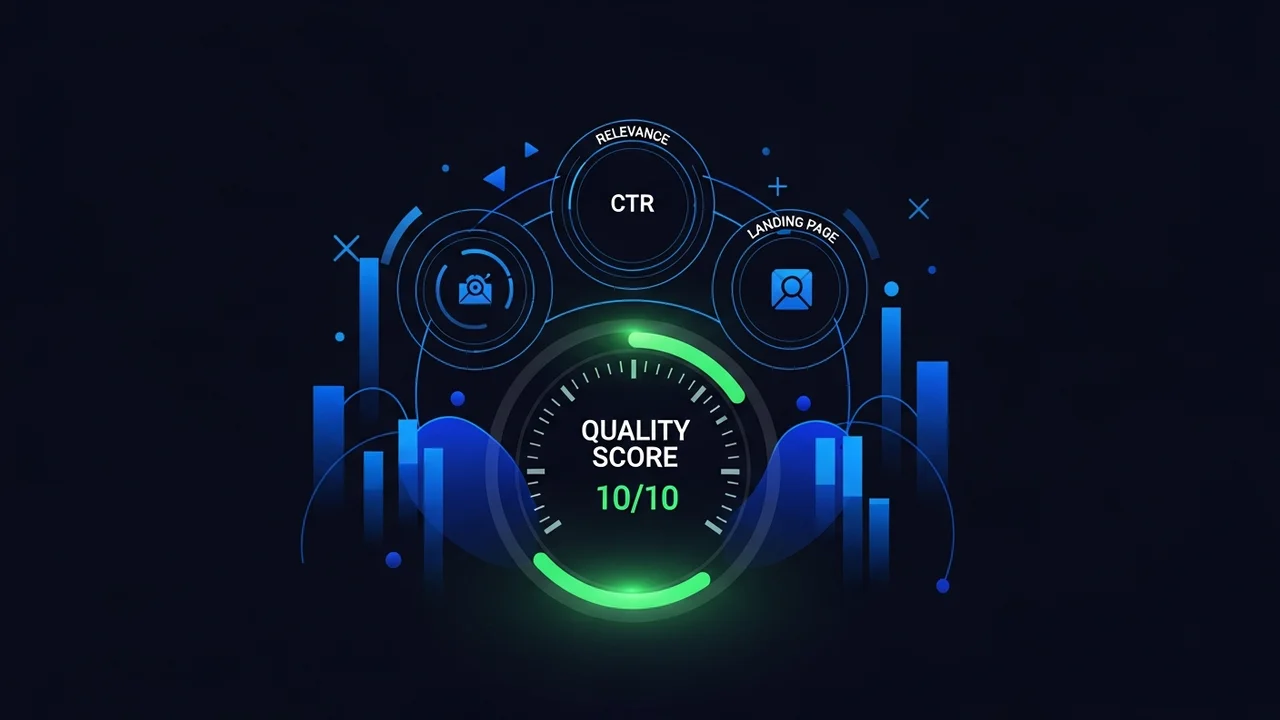

Quality Score is Google's 1-to-10 estimate of how relevant your keyword, ad, and landing page are to a user's search. It is the single biggest lever in your account: a Quality Score of 9 routinely pays 50-80% less per click than a Quality Score of 4 for the same keyword. This guide covers exactly what Quality Score is, what it isn't, and the playbook proven media buyers use to drive it up.
What Quality Score Actually Measures
Quality Score is a diagnostic at the keyword level. Google publishes it on a 1-10 scale, but the score you see in the UI is a smoothed approximation of an internal real-time ranking signal called Ad Rank.
- Expected CTR: The likelihood your ad will be clicked for this exact keyword, normalized for ad position. This is the highest-weighted of the three factors.
- Ad Relevance: How closely your ad copy matches the keyword's intent. Generic ad copy across many keywords tanks this.
- Landing Page Experience: Page load speed, mobile usability, content match, transparency, and navigation clarity.
What a Good Quality Score Looks Like
- 9-10: Best in class. CPCs are typically 30-50% below auction average.
- 7-8: Healthy. Most well-managed accounts live here.
- 5-6: Average. Significant CPC penalty vs. the leaders.
- 3-4: Below average. You'll struggle to compete on bid alone.
- 1-2: Broken. Either the keyword is wildly off-intent or the landing page violates expectations.
Aged Google Ads accounts with 6-month billing history outperform new accounts by 40 to 60 percent on the same campaign in our internal A/B tests across 200+ client launches.
The Three Components, Decoded
Expected CTR, the heaviest weight
Google compares your historical CTR for that keyword to other advertisers bidding on the same query, then normalizes for position. Improving CTR is the single fastest path to a higher QS. Tactics: tighter keyword-to-ad matching (single-keyword ad groups for high-volume terms), DKI (dynamic keyword insertion) where it makes sense, brutal pruning of low-CTR ads via responsive search ad ad-strength reporting, and using all 15 headlines / 4 descriptions to give Google enough material to test.
Ad Relevance, easy to fix, easy to forget
Each ad group should target a tight semantic cluster. If you have 80 keywords and 1 generic ad, ad relevance will collapse. Best practice: SKAG (single keyword ad group) for top spenders, STAG (single theme ad group) for everything else. Mention the exact keyword in at least one headline of every responsive search ad.
Landing Page Experience, the slowest to move
Google evaluates: time to interactive, mobile responsiveness, content match between ad and page, presence of trust signals (privacy policy, contact info), and navigation clarity. Page experience updates can take 1-2 weeks to propagate after fixes go live.
The 7-Step Playbook to Move QS From 4 to 9
- Audit your worst keywords first. Add the QS column to keyword reports. Filter to keywords with QS <= 5 and impression volume > 100/day. These are where the money is hiding.
- Tighten ad groups. Split any ad group with more than 10 keywords or more than 2 distinct themes into multiple groups. Aim for max 3-5 closely-related keywords per group.
- Rewrite ads to match the keyword. Each ad group should have one RSA where keyword text appears in >= 2 of the 15 headlines.
- Cut underperforming RSAs. Pause any RSA with ad strength "Poor" that hasn't moved after 14 days. Replace with a new RSA built from the top-performing assets.
- Improve landing page Core Web Vitals. LCP < 2.5s, INP < 200ms, CLS < 0.1. Use PageSpeed Insights field data, not lab data.
- Match the page H1 to the ad headline. The semantic alignment between ad copy and landing page H1 is one of Google's strongest landing-page-experience signals.
- Wait 7-14 days before re-evaluating. QS is a smoothed signal. Don't make changes faster than the system can recompute.
Quality Score Myths to Stop Believing
- Myth: QS affects Performance Max. PMax doesn't expose keyword QS. The same intent signals matter, but the lever is asset group quality and audience signals, not keyword QS.
- Myth: A higher bid raises QS. Bid never enters the QS calculation. Bid affects rank, not quality.
- Myth: QS is recalculated daily. The score in the UI updates daily, but the underlying signals are continuous and weighted toward recent data.
- Myth: Pausing a low-QS keyword removes the penalty. Account-level historical quality data persists. Pausing only stops new impressions on that exact keyword.
Quality Score isn't a vanity metric, it's the multiplier that decides whether you outbid a competitor at $3 CPC or pay $7 for the same click. Treat the keyword-level QS column as the most important diagnostic in your account, and revisit it weekly.
Want a Senior Media Buyer to Audit Your Account?
Unled Network's managed campaign team runs free Quality Score audits for accounts spending over 0K/month. We'll identify the keywords killing your CPC and ship a 30-day remediation plan.
Comments
Have a question or a first-hand experience with this? Join the conversation. Your email is never shown or shared.
We implemented this approach last month and already seeing positive signals. Thanks for the detail.
Good point. We've refined our internal playbook for exactly this scenario. The approach in this article works well for google ads quality score complete g.